
GTest源码分析——用例注册与执行过程
google/googletest | DeepWiki
Google Test(GTest)使用方法和源码解析——自动调度机制分析_&test::testbody-CSDN博客
本文不是按照阅读源码时的分析顺序,而是在阅读源码后,将涉及到的数据结构、函数放在最前面,最后再分析执行流程的。所以在分析执行流程时,不再分析函数逻辑了,不记得了就在上文找。
本文给出的源码,都经过了删减,只展示部分逻辑。
HandleExceptionsInMethodIfSupported() 函数
兼容C++异常/Windows SEH异常的函数,内部就是帮你执行 object::method() :
template <class T, typename Result>
Result HandleExceptionsInMethodIfSupported(T* object, Result (T::*method)(),const char* location) {if (internal::GetUnitTestImpl()->catch_exceptions()) {// ...return (object->*method)();}
}
UnitTest 类
就是一个存储了一堆 TestSuites 的容器。这个类对象以单例形式存在,是GTest框架中其他类之间沟通的桥梁。
这个类采用 Pimpl 设计,所以还有一个 UnitTestImpl 实现类。
UnitTestImpl::AddTestInfo() 函数
void AddTestInfo(internal::SetUpTestSuiteFunc set_up_tc,internal::TearDownTestSuiteFunc tear_down_tc,TestInfo* test_info) {GetTestSuite(test_info->test_suite_name_, test_info->type_param(),set_up_tc, tear_down_tc)->AddTestInfo(test_info);
}
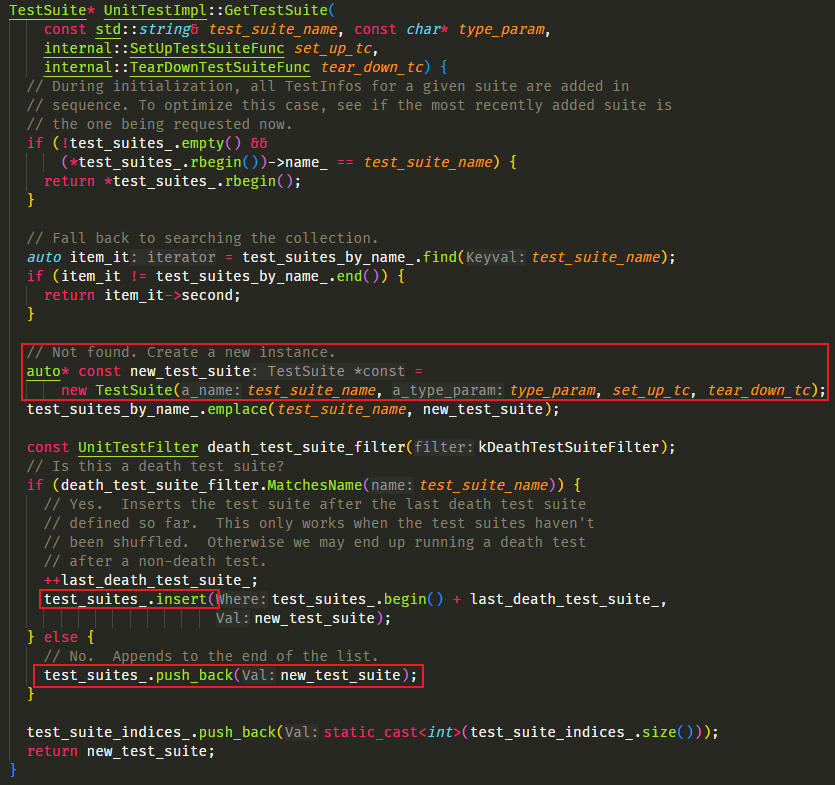
UniTestImpl::GetTestSuite() 函数
UnitTestImpl::GetTestSuite() 会尝试查找是否存在已有的同名 TestSuite 对象,没有就新建一个:
UnitTestImpl::RunAllTests() 函数
bool UnitTestImpl::RunAllTests() {// 启动监听器TestEventListener* repeater = listeners()->repeater();repeater->OnTestProgramStart(*parent_);// How many times to repeat the tests?  We don't want to repeat them// when we are inside the subprocess of a death test.const int repeat = in_subprocess_for_death_test ? 1 : GTEST_FLAG_GET(repeat);// Repeats forever if the repeat count is negative.const bool gtest_repeat_forever = repeat < 0;// 每轮循环是一遍全量测试for (int i = 0; gtest_repeat_forever || i != repeat; i++) {// Tells the unit test event listeners that the tests are about to start.repeater->OnTestIterationStart(*parent_, i);// Runs each test suite if there is at least one test to run.if (has_tests_to_run) {// Sets up all environments beforehand. If test environments aren't// recreated for each iteration, only do so on the first iteration.if (i == 0 || recreate_environments_when_repeating) {repeater->OnEnvironmentsSetUpStart(*parent_);ForEach(environments_, SetUpEnvironment);repeater->OnEnvironmentsSetUpEnd(*parent_);}// Runs the tests only if there was no fatal failure or skip triggered// during global set-up.if (Test::IsSkipped()) {// Emit diagnostics when global set-up calls skip, as it will not be// emitted by default.TestResult& test_result =*internal::GetUnitTestImpl()->current_test_result();for (int j = 0; j < test_result.total_part_count(); ++j) {const TestPartResult& test_part_result =test_result.GetTestPartResult(j);}fflush(stdout);} else if (!Test::HasFatalFailure()) {// 遍历所有 TestSuite 并调用其 Run 方法for (int test_index = 0; test_index < total_test_suite_count();test_index++) {GetMutableSuiteCase(test_index)->Run(); // 执行测试if (GTEST_FLAG_GET(fail_fast) &&GetMutableSuiteCase(test_index)->Failed()) {for (int j = test_index + 1; j < total_test_suite_count(); j++) {GetMutableSuiteCase(j)->Skip();}break;}}} else if (Test::HasFatalFailure()) {// If there was a fatal failure during the global setup then we know we// aren't going to run any tests. Explicitly mark all of the tests as// skipped to make this obvious in the output.for (int test_index = 0; test_index < total_test_suite_count();test_index++) {GetMutableSuiteCase(test_index)->Skip();}}// Tears down all environments in reverse order afterwards. If test// environments aren't recreated for each iteration, only do so on the// last iteration.if (i == repeat - 1 || recreate_environments_when_repeating) {repeater->OnEnvironmentsTearDownStart(*parent_);std::for_each(environments_.rbegin(), environments_.rend(),TearDownEnvironment);repeater->OnEnvironmentsTearDownEnd(*parent_);}}// Tells the unit test event listener that the tests have just finished.repeater->OnTestIterationEnd(*parent_, i);// Gets the result and clears it.if (!Passed()) {failed = true;}}repeater->OnTestProgramEnd(*parent_);// Destroy environments in normal code, not in static teardown.bool delete_environment_on_teardown = true;if (delete_environment_on_teardown) {ForEach(environments_, internal::Delete<Environment>);environments_.clear();}return !failed;
}
TestFactory 类
其是一个类工厂,利用多态和模板:
// Defines the abstract factory interface that creates instances
// of a Test object.
class TestFactoryBase {public:virtual ~TestFactoryBase() = default;// Creates a test instance to run. The instance is both created and destroyed// within TestInfoImpl::Run()virtual Test* CreateTest() = 0;protected:TestFactoryBase() {}private: // 禁止拷贝TestFactoryBase(const TestFactoryBase&) = delete;TestFactoryBase& operator=(const TestFactoryBase&) = delete;
};// This class provides implementation of TestFactoryBase interface.
// It is used in TEST and TEST_F macros.
template <class TestClass>
class TestFactoryImpl : public TestFactoryBase {public:Test* CreateTest() override { return new TestClass; }
};
Test 类
代表一个测试用例本身。是纯粹的测试逻辑。
Test::Run() 函数
就是执行宏生成/自己写的 Test 子类的钩子函数:SetUp() --> TestBody() --> TearDown()
void Test::Run() {internal::UnitTestImpl* const impl = internal::GetUnitTestImpl();impl->os_stack_trace_getter()->UponLeavingGTest();internal::HandleExceptionsInMethodIfSupported(this, &Test::SetUp, "SetUp()");// We will run the test only if SetUp() was successful and didn't call// GTEST_SKIP().if (!HasFatalFailure() && !IsSkipped()) {impl->os_stack_trace_getter()->UponLeavingGTest();internal::HandleExceptionsInMethodIfSupported(this, &Test::TestBody,"the test body");}// However, we want to clean up as much as possible.  Hence we will// always call TearDown(), even if SetUp() or the test body has// failed.impl->os_stack_trace_getter()->UponLeavingGTest();internal::HandleExceptionsInMethodIfSupported(this, &Test::TearDown,"TearDown()");
}
TestInfo 类
TestInfo 类存储了一个测试的名字、是否应该被执行等元信息,并负责管理用户的测试类的生命周期。
其地位是连接 Test 类与 TestSuite 类,持有注入的工厂实例来负责 Test 类实例的构造与销毁。
TestInfo::Run() 函数
该函数负责创建用户通过 TEST/TEST_F 宏生成的测试类的对象,并执行该对象的 TestBody() 函数并报告执行结果,最后释放内存。
void TestInfo::Run() {TestEventListener* repeater = UnitTest::GetInstance()->listeners().repeater();UnitTest::GetInstance()->set_current_test_info(this);// Notifies the unit test event listeners that a test is about to start.repeater->OnTestStart(*this);result_.set_start_timestamp(internal::GetTimeInMillis());UnitTest::GetInstance()->UponLeavingGTest();// 创建Test对象Test* const test = internal::HandleExceptionsInMethodIfSupported(factory_, &internal::TestFactoryBase::CreateTest,"the test fixture's constructor");// 执行测试if (!Test::HasFatalFailure() && !Test::IsSkipped()) {test->Run();}if (test != nullptr) {// Deletes the test object.UnitTest::GetInstance()->UponLeavingGTest();internal::HandleExceptionsInMethodIfSupported(test, &Test::DeleteSelf_, "the test fixture's destructor");}// Notifies the unit test event listener that a test has just finished.repeater->OnTestEnd(*this);UnitTest::GetInstance()->set_current_test_info(nullptr);
}
TestSuite 类
就是一个存储了一堆 TestInfo 的容器。
TestSuite::AddTestInfo() 函数
void TestSuite::AddTestInfo(TestInfo* test_info) {test_info_list_.push_back(test_info);test_indices_.push_back(static_cast<int>(test_indices_.size()));
}
TestSuite::Run() 函数
void TestSuite::Run() {UnitTest::GetInstance()->set_current_test_suite(this);TestEventListener* repeater = UnitTest::GetInstance()->listeners().repeater();repeater->OnTestSuiteStart(*this);UnitTest::GetInstance()->UponLeavingGTest();// 调用绑定的 SetUp 方法internal::HandleExceptionsInMethodIfSupported(this, &TestSuite::RunSetUpTestSuite, "SetUpTestSuite()");// 开始执行测试for (int i = 0; i < total_test_count(); i++) {if (skip_all) {GetMutableTestInfo(i)->Skip();} else {GetMutableTestInfo(i)->Run();}if (GTEST_FLAG_GET(fail_fast) &&GetMutableTestInfo(i)->result()->Failed()) {for (int j = i + 1; j < total_test_count(); j++) {GetMutableTestInfo(j)->Skip();}break;}}UnitTest::GetInstance()->UponLeavingGTest();// 调用绑定的 TearDown 方法internal::HandleExceptionsInMethodIfSupported(this, &TestSuite::RunTearDownTestSuite, "TearDownTestSuite()");repeater->OnTestSuiteEnd(*this);UnitTest::GetInstance()->set_current_test_suite(nullptr);
}
TEST / TEST_F 宏
这两个宏会展开为:
#define GTEST_TEST(test_suite_name, test_name) \GTEST_TEST_(test_suite_name, test_name, ::testing::Test, \::testing::internal::GetTestTypeId())#define GTEST_TEST_F(test_fixture, test_name) \GTEST_TEST_(test_fixture, test_name, test_fixture, \::testing::internal::GetTypeId<test_fixture>())
可以看到,其实使用 TEST 还是 TEST_F 本质都是一样的,只不过差在继承关系和是否重写了 SetUp()/TearDown() 方法:
GTEST_TEST_ 宏
而 GTEST_TEST_ 会展开如下:
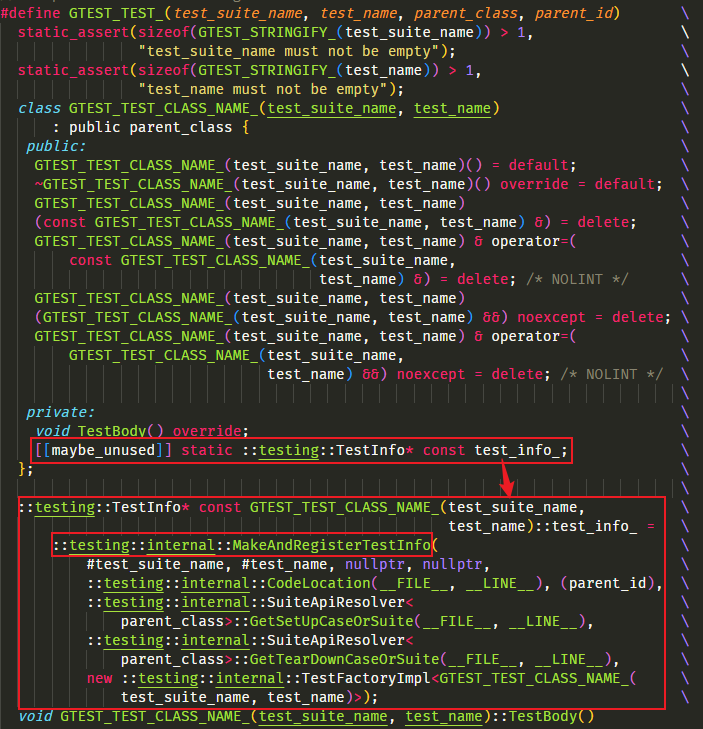
它是为每个“用例函数”生成了一个用例类,类禁用了拷贝和移动语义,继承自 ::testing::Test ,具有一个虚函数 TestBody() 并放在宏最后用于承接 TEST() { ... } 的函数体。且定义了一个静态变量 test_info_ ,利用静态变量在 main 执行之前被初始化的规则,将注册用例的操作 MakeAndRegisterTestInfo() 作为 test_info_ 的初始化过程,从而能自动在程序开始前执行注册逻辑。
MakeAndRegisterTestInfo() 函数
它是就地通过 __FILE__ 和 __LINE__ 保存了代码位置到 CodeLocation ,通过 TestFactory 创建了 TestInfo ,然后调用 UnitTestImpl::AddTestInfo() 记录这个 TestInfo 。
// Creates a new TestInfo object and registers it with Google Test;
// returns the created object.
//
// Arguments:
//
//   test_suite_name:  name of the test suite
//   name:             name of the test
//   type_param:       the name of the test's type parameter, or NULL if
//                     this is not a typed or a type-parameterized test.
//   value_param:      text representation of the test's value parameter,
//                     or NULL if this is not a value-parameterized test.
//   code_location:    code location where the test is defined
//   fixture_class_id: ID of the test fixture class
//   set_up_tc:        pointer to the function that sets up the test suite
//   tear_down_tc:     pointer to the function that tears down the test suite
//   factory:          pointer to the factory that creates a test object.
//                     The newly created TestInfo instance will assume
//                     ownership of the factory object.
TestInfo* MakeAndRegisterTestInfo(std::string test_suite_name, const char* name, const char* type_param,const char* value_param, CodeLocation code_location,TypeId fixture_class_id, SetUpTestSuiteFunc set_up_tc,TearDownTestSuiteFunc tear_down_tc, TestFactoryBase* factory) {TestInfo* const test_info =new TestInfo(std::move(test_suite_name), name, type_param, value_param,std::move(code_location), fixture_class_id, factory);GetUnitTestImpl()->AddTestInfo(set_up_tc, tear_down_tc, test_info);return test_info;
}
RUN_ALL_TESTS() 函数
在此之前还有个用于解析命令行参数的 InitGoogleTest() ,那个不重要。通过 UniTest 单例来执行:
inline int RUN_ALL_TESTS() { return ::testing::UnitTest::GetInstance()->Run(); }int UnitTest::Run() {// Captures the value of GTEST_FLAG(catch_exceptions).  This value will be// used for the duration of the program.impl()->set_catch_exceptions(GTEST_FLAG_GET(catch_exceptions));}return internal::HandleExceptionsInMethodIfSupported(impl(), &internal::UnitTestImpl::RunAllTests,"auxiliary test code (environments or event listeners)")? 0: 1;
}
所以就相当于 UnitTest::impl()->RunAllTests() 。
其中 impl_ 对象在 UnitTest 单例创建时被创建:
UnitTest::UnitTest() { impl_ = new internal::UnitTestImpl(this); }
UnitTestImpl::RunAllTests() 分析见上文。
整体流程
类图
执行流
总结
类之间的关系
在 GoogleTest 的架构中,类之间的关系是:
- UnitTest (单例) → 管理多个 TestSuite → 每个包含多个 TestInfo → 每个通过其构造时注入的工厂类实例来创建 Test 实例。
- 即通过所有属于同一个 text fixture 的用例,每个都对应一个自己的
Test子类实例和TestInfo实例,最终都会存储在同一个TestSuite实例中。而所有的TestSuite实例又存储在UnitTest单例中。
用例注册过程
TEST/TEST_F宏展开声明了一个最终继承于Test的子类- 声明了一个虚函数
TestBody() - 声明了一个静态成员变量
::testing::TestInfo* const test_info_
- 声明了一个虚函数
- 在类外,利用
MakeAndRegisterTestInfo初始化了静态成员变量test_info_- 其中访问
UnitTest单例会使得在main函数执行前就将所有测试用例都注册到UnitTest单例中。
- 其中访问
- 最后输出了
TestBody()的函数签名,此时会连上我们测试用例的函数体。
用例执行过程
TestSuite::Run() 方法遍历所有 TestInfo,为每个测试:
- 调用
SetUpTestSuite()(整个套件执行一次) - 为每个测试创建新的
Test实例 - 调用
Test::SetUp() - 执行
Test::TestBody()(测试逻辑) - 调用
Test::TearDown() - 删除
Test实例 - 调用
TearDownTestSuite()(整个套件执行一次)