
Deep Learning|01 RBF Network
文章目录
- Deep Learning|01 RBF Network
- Radial Basis Function Interpolation, RBF Interpolation
- RBF Network
- How to build a simple RBF network?
Radial Basis Function Interpolation, RBF Interpolation
Radial basis functions are a class of real-valued functions that depend solely on the radial distance between the input vector and a fixed center point. Their core characteristic is that the function value is independent of the direction of the input and only related to the distance from the input to the center point.
Let Φ(x)\Phi (x)Φ(x)is a RBF , for any input vectorx\boldsymbol{x}x, and center vectorsc\boldsymbol{c}c,we defineΦ(x)\Phi (x)Φ(x)uesd Gauss functon :
Φ(x)=e−β∥x−c∥2\Phi(\boldsymbol{x})=e^{-\beta \|\boldsymbol{x}-\boldsymbol{c}\|^2}Φ(x)=e−β∥x−c∥2
which β\betaβcontrol the width of Gauss functon .
Note: It is not the only way. In fact, any similar δ\deltaδfunction is available.
Radial Basis Function Interpolation, RBF Interpolation , is essentially an interpolation method that use a linear combination of radial basis functions (RBFs) to
“exactly approximate” the functionf(x)f(x)f(x)at known points.The formular is as follows:
f(x)=∑j=1nλjΦj(x)=∑j=1nλje−βj∥x−cj∥2f(x)= \sum_{j=1}^{n} \lambda_j\Phi_j (\boldsymbol{x})= \sum_{j=1}^{n} \lambda_je^{-\beta_j \|\boldsymbol{x}-\boldsymbol{c}_j\|^2}f(x)=j=1∑nλjΦj(x)=j=1∑nλje−βj∥x−cj∥2
This defination is likeMaximum Likelihood Estimation。This likely unrigorous?No! Brommehead and Lowe had given the proof of
RBF
. Magically!
RBF Network
Radial Basis Function Network (RBF Network) is a type of feedforward neural network with a single hidden layer. Its core feature is that it adopts “radial basis functions (RBFs)” as the activation functions of the hidden layer, and it is specifically used to solve supervised learning tasks such as nonlinear regression, pattern classification, and function approximation. Its key advantages lie in “strong local approximation capability, fast training speed, and stable generalization performance”, making it widely applied in small and medium-sized nonlinear problems.
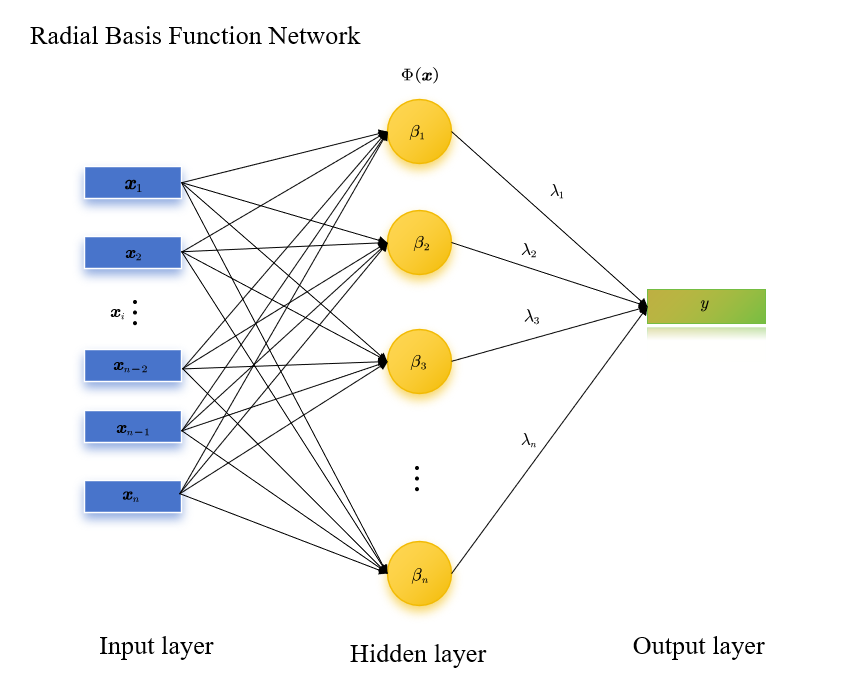
RBF Network=∑j=1nλjΦj(x)\text{RBF Network}=\sum_{j=1}^{n} \lambda_j\Phi_j (\boldsymbol{x})RBF Network=j=1∑nλjΦj(x)
How to build a simple RBF network?
Aassuming we have series data{(x,y)}i=1n\{\left(\boldsymbol{x},y\right)\}_{i=1}^n{(x,y)}i=1n, the training objective of an RBF network is to determine three types of parameters: hidden layer centers{ci}inc\{\boldsymbol{c}_i\}_{i}^{n_c}{ci}inc, hidden layer widths{σi}inσ\{\sigma_i\}_{i}^{n_\sigma}{σi}inσ, and output layer weights{wi}inw\{w_i\}_{i}^{n_w}{wi}inw.
Step1: load data and K-means clustering
import pandas as pd
import numpy as np
import matplotlib.pyplot as plt
from sklearn.cluster import KMeans
from sklearn.preprocessing import StandardScaler
import os
def preprocess_data(data):
data = data.dropna()
if data.dtypes.iloc[-1] == 'object' or len(data.iloc[:, -1].unique()) < 10:
X = data.iloc[:, :-1].values
has_labels = True
labels = data.iloc[:, -1].values
else:
X = data.values
has_labels = False
labels = None
scaler = StandardScaler()
X_scaled = scaler.fit_transform(X)
return X_scaled, has_labels, labels
def perform_kmeans(X, n_clusters=neural_numbers, random_state=42):
kmeans = KMeans(n_clusters=n_clusters, random_state=random_state)
clusters = kmeans.fit_predict(X)
centroids = kmeans.cluster_centers_
return clusters, centroids
def visualize_results(X, original_labels, clusters, centroids, has_original_labels=False):
fig, axes = plt.subplots(1, 2, figsize=(16, 8))
has_original_labels and original_labels is not None:
scatter1 = axes[0].scatter(X[:, 0], X[:, 1], c=original_labels, cmap='viridis', alpha=0.7)
axes[0].set_title('oringal data distrbution', fontsize=14)
plt.colorbar(scatter1, ax=axes[0], label='oringal lable')
scatter2 = axes[1].scatter(X[:, 0], X[:, 1], c=clusters, cmap='viridis', alpha=0.7)
axes[1].scatter(centroids[:, 0], centroids[:, 1], s=300, c='red', marker='X', label='clustering center')
axes[1].set_title('result of clustering', fontsize=14)
plt.colorbar(scatter2, ax=axes[1], label='clustering label')
axes[1].legend()
for ax in axes:
ax.set_xlabel('feature_1(标准化)', fontsize=12)
ax.set_ylabel('feature_2(标准化)', fontsize=12)
ax.grid(True, linestyle='--', alpha=0.6)
plt.tight_layout()
if not os.path.exists('results'):
os.makedirs('results')
plt.savefig('results/clustering_comparison.png', dpi=300, bbox_inches='tight')
print("figures save to : results/clustering_comparison.png")
plt.show()
def main(file_path, n_clusters=3):
data = load_data(file_path)
if data is None:
return
X, has_labels, original_labels = preprocess_data(data)
if X.shape[1] > 2:
from sklearn.decomposition import PCA
print(f"data dimension is {X.shape[1]},use PCA to 2-dimension to showase")
pca = PCA(n_components=2)
X = pca.fit_transform(X)
clusters, centroids = perform_kmeans(X, n_clusters)
visualize_results(X, original_labels, clusters, centroids, has_labels)
if __name__ == "__main__":
datapath="data.csv"
neural_numbers=3
data = pd.read_csv(file_path) # Must .csv
main(datapath, neural_numbers)
**Step2: Calculate the hidden layer widths **$
The widths do not require training and are usually calculated automatically based on the distribution of the centers.Most commonly used,adaptive calculation based on “nearest neighbor center distance”
For each centercj\boldsymbol{c}_jcj, first find another centerck\boldsymbol{c}_kckthat is closest to it (k≠jk \neq jk=j), and denote this distance asdjd_jdj:
dj=mink=1,2,...,nk≠j∥cj−ck∥d_j = \min_{\substack{k=1,2,...,n \\ k \neq j}} \|\boldsymbol{c}_j - \boldsymbol{c}_k\|dj=k=1,2,...,nk=jmin∥cj−ck∥
(wheredjd_jdjrepresents the Euclidean distance from thejjj-th center to its nearest neighboring center)
Then, defineβj\beta_jβjas a quantity related todjd_jdjto ensure that the “effective range” of the RBF matches the distance between adjacent centers:
βj=12⋅dj2\beta_j = \frac{1}{2 \cdot d_j^2}βj=2⋅dj21
Step3: Solve for the output layer weights
After the centers{ci}\{\boldsymbol{c}_i\}{ci}and widths{σi}\{\sigma_i\}{σi}are determined, the hidden layer outputhi(x)h_i(\boldsymbol{x})hi(x)can be regarded as a “fixed nonlinear feature”. At this point, the solution for the output layer weights is transformed into alinear regression problem(gradient descent is not required, and the least squares method can be used directly).
Suppose the training set containsNNNsamples(xk,yk)(\boldsymbol{x}_k, y_k)(xk,yk)(whereyky_kykis the true label), and the network output is$y^k=∑i=1mwihi(xk)+w0\hat{y}_k = \sum_{i=1}^m w_i h_i(\boldsymbol{x}_k) + w_0y^k=∑i=1mwihi(xk)+w0. By minimizing the “squared error between the predicted value and the true value”:
L=∑k=1N(y^k−yk)2\mathcal{L} = \sum_{k=1}^N (\hat{y}_k - y_k)^2L=k=1∑N(y^k−yk)2
This can be converted into the matrix equationH⋅w=y\mathbf{H} \cdot \boldsymbol{w} = \boldsymbol{y}H⋅w=y), where:
- H\mathbf{H}H is an N×(m+1)N \times (m+1)N×(m+1)“feature matrix”, and each row is[1,h1(xk),h2(xk),...,hm(xk)][1, h_1(\boldsymbol{x}_k), h_2(\boldsymbol{x}_k), ..., h_m(\boldsymbol{x}_k)][1,h1(xk),h2(xk),...,hm(xk)](the 1 corresponds to the bias termw0w_0w0);
- w=[w0,w1,...,wm]T\boldsymbol{w} = [w_0, w_1, ..., w_m]^Tw=[w0,w1,...,wm]Tis the weight vector to be solved;
- y=[y1,y2,...,yN]T\boldsymbol{y} = [y_1, y_2, ..., y_N]^Ty=[y1,y2,...,yN]Tis the true label vector.
The weights are solved using thepseudoinverse matrix(to avoid the problem of matrix singularity):
w=(HTH)−1HTy\boldsymbol{w} = (\mathbf{H}^T \mathbf{H})^{-1} \mathbf{H}^T \boldsymbol{y}w=(HTH)−1HTy
This step is the key to the fast training of the RBF network — linear problems can be solved directly without repeated iterations.